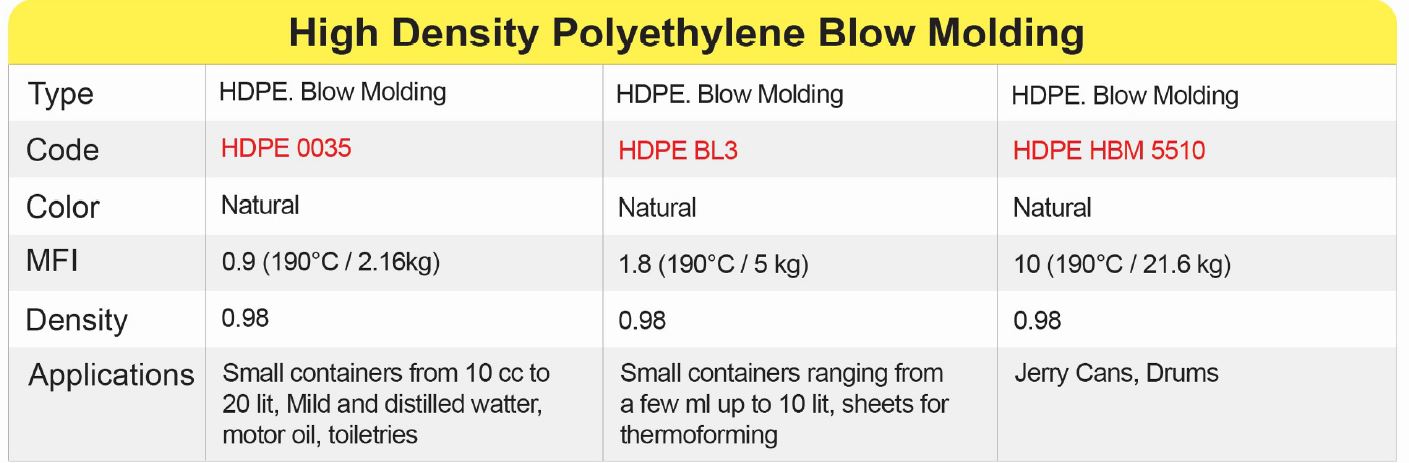
Blow molding is an industrial manufacturing process used to create hollow plastic parts. Many different industries utilize plastic blow molding, including the automotive industry — for tanks, intake assemblies, and ducting, among other components — and the agricultural industry, for bulk containers, irrigation parts, and fluid reservoirs. But perhaps the most well-known use for blow molding is in the packaging industry, where the process is used to make plastic bottles and other enclosures for everything from water to beauty products to cleaning solutions.
Plastic blow molding offers a reliable and affordable method to create plastic parts at scale. Like many manufacturing processes, initial start-up costs can be high, so blow molding often begins to make economic sense only when a manufacturer needs to create thousands of the same part. While some methodologies allow for greater complexity than others, blow molding is likely to be most effective for hollow, thin-walled shapes.
Compared to injection molding, plastic blow molding typically has a lower tooling cost. Likewise, many different materials can be blow molded, making it an appropriate process for a wide variety of applications.
In the blow molding process, pressurized air is forced through a nozzle into a heated plastic preform, which expands to fit the contours of a mold. Through this process, a thin plastic wall is formed in the shape of a mold, leaving a hollow cavity. The plastic is then cooled until it no longer needs the mold to retain its shape. Finally, the mold is removed, excess plastic is trimmed, and the plastic part is tested for quality before being shipped.
1. Preform Heating
How a preform is created differs between the three main blow molding processes: EBM, IBM, and ISBM. This article will describe those differences in detail in the ‘Blow Molding Process Types’ section.
Once the preform is created, it must be heated to a specific temperature that allows it to retain its integrity while being filled with pressurized air. Depending on the process and type of plastic, the preform may already be heated to a temperature that allows it to expand to fit the mold. In other cases, tools like band heaters and ring heaters are used to bring the preform into the thermoelastic temperature range.
The proper temperature varies based on the material, methodology, and desired finished product. Polyethylene terephthalate (PET), a material often used to create beverage containers, is typically heated to around 100° C. In order to achieve consistent wall thickness and avoid damaging the final product, it is very important to ensure the preform is heated evenly.
2. Molding
Once the preform is malleable, pressurized air is delivered through a nozzle. Like a balloon, the preform inflates until the thin plastic walls fit the contours of the cavity. Molds may give the bottle different shapes and textures and include logos and lettering. As with other types of molding, including compression molding and injection molding, blow molds allow for excess plastic to escape the mold to avoid pressure buildup and ensure consistent results.
Pressurized air must be delivered at a consistent pace that allows for the preform to expand without cracking or tearing. More complex molds may increase the per-part production time, leading to an increase in cost.
3. Cooling and Solidification
After the hollow body is created, it must be cooled until it drops out of the thermoelastic range so that it retains its shape once the mold is removed. Therefore, an efficient and effective cooling system can have a large impact on the efficiency of any blow molding process.
As with heating and molding, cooling and solidification must be done evenly to avoid damage. Additionally, cooling too fast can lead to deformities and inconsistencies in the finished part. Many blow molding machines use chilled compressed air and/or fluid cooling channels to increase the efficiency of the blow molding process.
4. De-Molding and Post-Processing
When the temperature has dropped below the thermoelastic range, the hollow body can be removed from the mold and transferred to a production line where it can be deflashed, trimmed, tested for any leaks, assessed for quality, and packaged for shipping.
In many modern manufacturing lines, de-molding and post-processing, including trimming and checking for leaks, can be almost completely automated, although especially large or custom designs may require manual finishing. However, human oversight is still a critical part of most blow molding processes for quality control purposes as well as for final packaging.
There are 3 main types of blow molded process. Explore them in detail:
- Extrusion Blow Molding

Extrusion blow molding (EBM), the most common type of blow molding, is also the simplest and least expensive. However, products created via EBM are typically limited in structural complexity and detail.
In EBM, molten plastic is forced through an extruder, forming a hollow tube: the parison. Then the mold closes around the parison. Next, pressurized air is used to inflate the parison until it completely fills the mold cavity, matching the inner contours of the mold.
After the parison has been fully inflated, the cooling and solidification process occurs, often with the assistance of fluid cooling channels or compressed air. However, since EBM is the most basic type of blow molding, some EBM machines rely upon cooling to occur naturally.
Extrusion blow molding is often used with polyethylene (PE), a popular plastic for agricultural tanks, automotive fluid (such as motor oil and coolant) bottles, shampoo bottles, and many other common products. EBM is also the most common method of blow molding nylon.
In addition to limited structural complexity and detail, manufacturing technicians may find that they are unable to achieve the variation in wall thickness that their product requires and be forced to turn to IBM or ISBM. However, for many applications such as simple containers and bottles, EBM is sufficient.
Additionally, although EBM only allows for a small to medium blow-up ratio, the final EBM-produced part can be quite large, making it the preferred method for producing products such as industrial drums, carrying cases, and fuel tanks.
- Injection Blow Molding
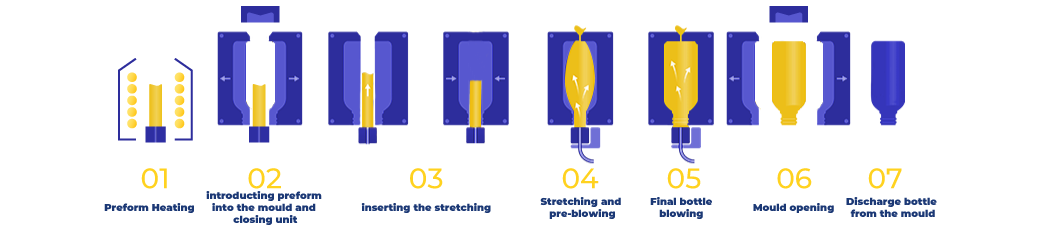
Injection blow molding (IBM) combines injection molding and blow molding. First, the preform is created by injecting molten plastic into a mold and then cooled to create a parison. Then the preform is transferred to the blow mold cavity, reheated, and filled with compressed air until it expands to fill the cavity of the blow mold. From that point on, the process is very similar to EBM: the molded plastic is cooled, removed from the blow mold, trimmed, and shipped.
However, the blow molding step does not always require that the parison be heated to the same temperature as when it was injection molded. This often makes injection blow molding a superior option for manufacturers working with materials that have a long drying time, such as PET, the material most frequently found in soft drink and water bottles.
IBM is also better suited than EBM for complex shapes or for products with tighter tolerances (for example, medicine bottles that have a strict neck tolerance). Manufacturers in the cosmetics and pharmaceutical industries are therefore likely to turn to injection blow molding due to its increased precision. Because of the multi-step process and added design complexity, however, tooling can be much pricier and the overall time per part typically exceeds that of EBM.
- Injection stretch blow molding
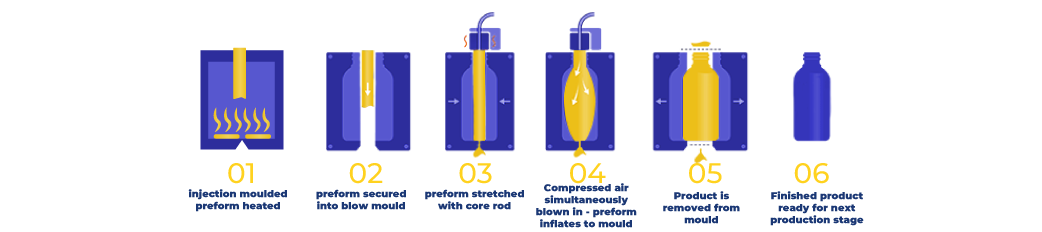
Like IBM, injection stretch blow molding (ISBM) is able to achieve greater part complexity and dimensional accuracy than EBM. Often, especially when using PET plastic, ISBM allows for even greater detail and finer design features than IBM. As an added bonus, some ISBM manufacturing processes reduce or eliminate excess plastic, which creates less waste and a smoother finished product.
ISBM is very similar to IBM in that it is a two-step process that begins by using injection molding to create the preform. However, once the preform is transferred to the blow mold and gets heated, a vertical rod is extended to stretch the preform before pressurized air is injected. This crucial extra step makes ISBM capable of producing ovoid, square, and polygonal shapes that other methods may struggle with.
ISBM involves an additional step — the stretching — compared with IBM, resulting in slightly longer processing times and, on average, the highest tooling costs of the three main methods of blow molding plastic.
Blow Molding Materials
| Grade | MFI (190°C/2.16kg) | Density | Application |
|---|---|---|---|
| HBM5520 | 0.25 | 0.955 | Multipurpose blow molding process small blow molded articles containers for household industrial chemicals automotive supplies foodstuffs toiletries and cosmetics |
| HBM5020 | 0.3 | 0.95 | Multipurpose blow molding process small blow molded bottles packaging of consumer and dangerous goods |
| HD-0035 | 0.35 | 0.959 | bottles for bleach motor oil toiletries mild and distilled water This grade is also used to make small containers (from 10L to 20L) |
| HBM-5510 | 10 (190°C/21.6Kg) | 0.955 | Large blow molding parts standard and lightweight Jerry cans |
| BL3 | 23 (190°C/21.6kg) | 0.954 | Small blow moulding Containers (up to 5 lit ) Packaging of pharmaceuticals & surfactants |